
Estimated reading time: 11 minutes
If you’re searching for family law lawyers to get advice in South Australia, you’re usually trying to answer the same questions fast: What will this cost? Can we do 50/50? What am I entitled to? Will I have to go to Court?
This is Awkar & Co’s plain-English Q&A guide to the most common “People also ask” questions — written to be informative and decision-focused.
General information only (not legal advice). Outcomes depend on facts, evidence, safety issues, and what the law requires in your specific circumstances.
Why this guide is written the way it is
Awkar & Co who are Family Law Lawyers, have prepared this guide to answer the real questions people ask when separation becomes urgent: cost, time, parenting, property, and what Court actually does. We write for outcomes — not noise.
Our standard: clear strategy, evidence discipline, and practical solutions that reduce conflict and protect your position. Where we reference the law or process, we prioritise official sources (e.g., the Federal Circuit and Family Court of Australia, Services Australia, AustLII, and the Attorney-General’s Department).
Reviewed: 13 February 2026 (South Australia)
Family law process in South Australia: the typical pathway
Most family law matters in South Australia move through a predictable pathway. The mistake is treating it like a “one-step” problem. It’s usually a sequence: stabilise → disclose → negotiate → formalise (and litigate only if necessary).
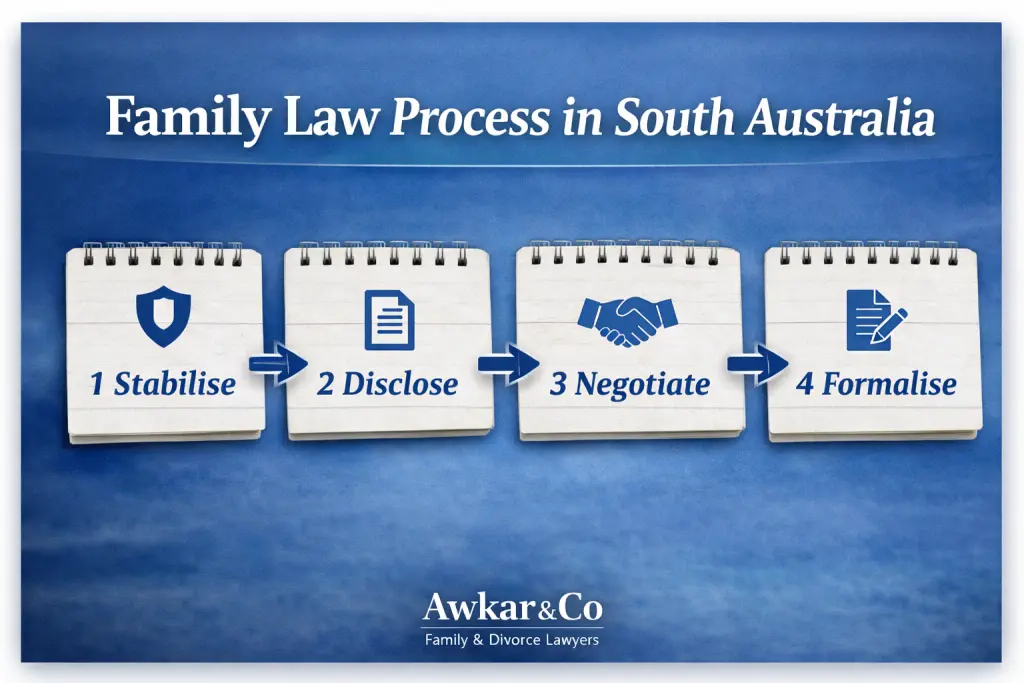
- Step 1 — Immediate stability: interim parenting routine, living arrangements, and boundaries for communication.
- Step 2 — Information & disclosure: gather financial documents, compile a timeline, and identify risks (safety, relocation, non-disclosure).
- Step 3 — Negotiation / dispute resolution: sensible offers, mediation where appropriate, and clear settlement terms.
- Step 4 — Formalise: consent orders, parenting orders, or a binding financial agreement (depending on what fits your facts).
- Step 5 — Court (if required): applications, affidavits, interim hearings, and final determination where settlement fails.
Practical rule: even if you intend to settle, prepare like you may need Court. That’s how you negotiate from strength and avoid last-minute panic.
How much does family Law lawyers cost in Australia?
Answer: Family lawyer costs vary significantly. The total usually depends on complexity, urgency, conflict level, and whether you need Court applications. The most reliable way to estimate cost is to ask for a written costs agreement and a staged plan (what happens at each stage, and what triggers extra cost).
What typically increases cost:
- High-conflict communication (long email wars that become evidence)
- Urgent parenting applications or contravention allegations
- Complex property pools (businesses, trusts, hidden assets, large debts)
- Poor disclosure (late, incomplete, or inconsistent financial documents)
Awkar & Co standard: we focus on early strategy, clean timelines, and evidence discipline. That’s how you control cost without weakening your position.
How do you choose the best family law lawyers?
Answer: Choose a family lawyer who can explain the strategy, not just the process. You want calm, credible advocacy, cost transparency, and a clear plan to settle (or litigate) efficiently.
- Relevant focus: parenting, property, child support, urgent applications — ask what they do most.
- Evidence mindset: timelines, documents, and proof — not emotion-led “storytelling”.
- Cost control: staged approach and clear triggers that change scope and budget.
- Reality checks: good advice includes what you don’t want to hear (and why).
Can a father get 50/50 custody in Australia?
Answer: Yes — but there is no automatic legal entitlement to equal time. Equal time happens if parents agree, or if a Court finds it’s in the child’s best interests. Australian Government guidance is explicit on this point. Official reference (Attorney-General’s Department).
What the Court must focus on: the child’s best interests. The Family Law Act sets out the factors the Court considers when determining best interests. Family Law Act s 60CC (AustLII).
Practical takeaway: If you want a workable shared-care arrangement, build it around school routine, communication boundaries, and low-conflict logistics. Courts favour stability and child-focused planning.
How does money work in a divorce? What am I entitled to?
Answer: Australia does not use a fixed “percentage formula”. The Court can alter property interests only if it is satisfied it is just and equitable to make an order. That requirement is written into the Act for married couples (s 79) and de facto couples (s 90SM).
About the “70/30 split” question: It’s a common internet shortcut, not a reliable predictor. Your outcome depends on the asset pool, contributions (financial and non-financial), and future needs — assessed on your evidence.
Critical deadline (people miss this): if you were married, property applications generally must be filed within 12 months of the divorce becoming final; for de facto relationships, generally within 2 years of separation (unless the Court gives leave). Official reference (FCFCOA).
Newer context: property and financial law has been updated in recent reforms, including changes commencing 10 June 2025. If your matter spans those dates, your strategy should be checked against the current framework. Official reference (FCFCOA reforms summary).
Why is moving out sometimes the biggest mistake during separation?
Answer: Moving out can be a mistake when it creates a new “status quo” that harms your parenting position, access to documents, or financial control. It is not always wrong — but it should be done with a plan, not on impulse.
- Parenting risk: you can accidentally normalise a reduced-care pattern.
- Evidence risk: you lose access to records, devices, or key documents.
- Money risk: you keep paying everything without documenting interim arrangements.
Awkar & Co rule: if safety is not the issue, don’t move without (1) a written interim parenting plan, (2) captured disclosure, and (3) a communications protocol.
Do you have to pay child support if you have the kids 50%?
Answer: Sometimes, yes. Child support is calculated using a formula that considers income and care percentage (among other steps). Equal care does not automatically mean “$0” if incomes are materially different. Official reference (Services Australia: basic formula).
If care percentages are disputed, Services Australia may request evidence and apply its care rules. Official reference (Services Australia: care percentage).
How much does it cost to go to Family Court without a lawyer?
Answer: Even if you self-represent, you still pay filing fees (unless you qualify for a reduced fee or exemption). For example, the Court lists an initiating application (Parenting AND Financial) at $710, and if you seek interim orders as well, an additional $150 can apply (total $860 in that scenario). Official reference (FCFCOA fee schedule).
Reality check: self-representing may reduce legal spend, but it often increases risk. Poor affidavits, missed deadlines, and weak evidence usually cost more in the end.
Who pays costs in Family Court in Australia?
Answer: Usually, each party pays their own legal costs. However, the Court can make costs orders in some circumstances. Official reference (FCFCOA: legal costs fact sheet).
The general rule is also set out in the Family Law Act. Family Law Act s 117 (AustLII).
What is the biggest mistake in a divorce or custody battle?
Answer: Emotional decision-making that damages your credibility. In family law, credibility is currency — and Courts decide on evidence, not outrage.
- Using children as leverage (backfires legally and personally)
- Sending long, aggressive messages (they become exhibits)
- Withholding disclosure or “forgetting” accounts/assets
- Filing applications without a coherent case theory
What is the best evidence for Family Court?
Answer: Objective evidence that is dated, consistent, and independently supported. Courts prefer records over opinions.
- School/childcare records and communications
- Medical records (where relevant and lawfully obtained)
- Police documents or orders (where relevant)
- Financial records: statements, tax returns, payslips, super
- A clean timeline with documents attached
What not to say to the judge?
Answer: Avoid exaggeration and labels. Don’t argue psychology, argue facts. Replace “They always/never…” with dates, events, and impact on the child.
Use this pattern instead: “On [date], [event]. The impact on the child was [specific outcome]. My proposal is [solution] because [child-focused reason].”
More questions people ask (fast answers)
Do we have to go to Court to get a divorce?
Answer: Usually, no. Many divorces are handled as an application process without a contested hearing, provided the requirements are met. If there are disputes about children or property, those are separate processes and don’t automatically require a divorce hearing.
What’s the difference between divorce and property settlement?
Answer: Divorce ends the marriage. Property settlement is the financial division of assets, debts, and (often) superannuation. You can negotiate and finalise property before or after divorce — but strict time limits can apply once divorce is final.
What’s the difference between a parenting plan and parenting orders?
Answer: A parenting plan is a written agreement between parents. Parenting orders are made by the Court and are legally enforceable. If you need enforceability (or there’s a pattern of non-compliance), orders are usually the safer option.
What are consent orders, and why do they matter?
Answer: Consent orders are Court orders made by agreement. They formalise parenting or property arrangements and can provide enforceability and finality — which reduces future disputes and protects you if circumstances deteriorate.
How long does a family law matter take?
Answer: Time depends on complexity and cooperation. Matters with clean disclosure and realistic negotiation can resolve quickly; high-conflict parenting or complex property disputes can take much longer, especially if Court timetables apply. The fastest path is usually early strategy + complete disclosure + disciplined communication.
What happens if my ex won’t disclose finances?
Answer: Non-disclosure is serious in property matters. The usual response is to escalate methodically: request disclosure in writing, identify what is missing, and if necessary use formal processes to compel production. The Court can draw adverse inferences and may make orders to deal with non-compliance.
What if the other parent breaches parenting orders?
Answer: Breaches can be addressed through contravention processes, but the best first move depends on risk and pattern. Document the breach calmly (dates, facts, messages), avoid escalating in front of the children, and get advice quickly — especially if safety or recovery issues arise.
Can grandparents get time with grandchildren?
Answer: Potentially, yes. The key question is whether the relationship and proposed arrangement are in the child’s best interests. Grandparent time is not “automatic,” but it can be agreed or ordered where appropriate.
Common scenarios (and what to do next)

We agree on the children, but not the property
Lock in a stable parenting routine, then move to disclosure and a property pool schedule. Property disputes escalate fastest when documents are incomplete or delayed.
We agree on property, but not the parenting arrangements
Keep communication disciplined and child-focused. Build a workable proposal around routine and logistics, then formalise if compliance is an issue.
There are safety concerns or urgent risk issues
Prioritise safety and immediate legal advice. Urgent matters require careful evidence handling and fast, correct steps — especially if children are at risk.
I suspect hidden assets or incomplete disclosure
Start with a structured disclosure list and a timeline. Identify gaps early and escalate methodically. The longer this is left, the more expensive it becomes.
Next step: get the strategy right early
If you’re separating, negotiating parenting arrangements, disputing child support, or facing a property settlement, the fastest way to reduce risk is a structured plan: evidence first, options second, Court readiness third (even if you aim to settle).
Explore related Awkar & Co resources
If you want deeper guidance on your exact situation, these pages expand on the strategies discussed above:
- Divorce in South Australia
- Separation advice & early strategy
- Parenting arrangements & parenting disputes
- Property settlement & financial agreements
- Child support guidance & next steps
- Speak with Awkar & Co (confidential)
Awkar & Co provides family law advice for clients in Norwood and nearby suburbs such as Kent Town, Stepney, Maylands, Kensington, Payneham and St Peters.