
Estimated reading time: 12 minutes
Parents often consider a private child support agreements when they want more certainty than the standard child support assessment provides. A private child support agreement can deal with ordinary child support payments, school fees, health insurance, medical expenses and other child-related costs. But the type of agreement matters. A limited child support agreement and a binding child support agreement can have very different consequences.
This guide explains the difference between limited and binding child support agreements, what each type can cover, when legal advice is required, how Services Australia fits in, and what parents in Adelaide and South Australia should check before signing. It is general information only. Child support agreements can have long-term financial and legal consequences, so tailored advice is important.
Child support agreements Australia: quick comparison
The two main formal types of private child support agreement are limited child support agreements and binding child support agreements, both of which are explained in the Child Support Guide. Both must be in writing and signed, but they are not interchangeable.
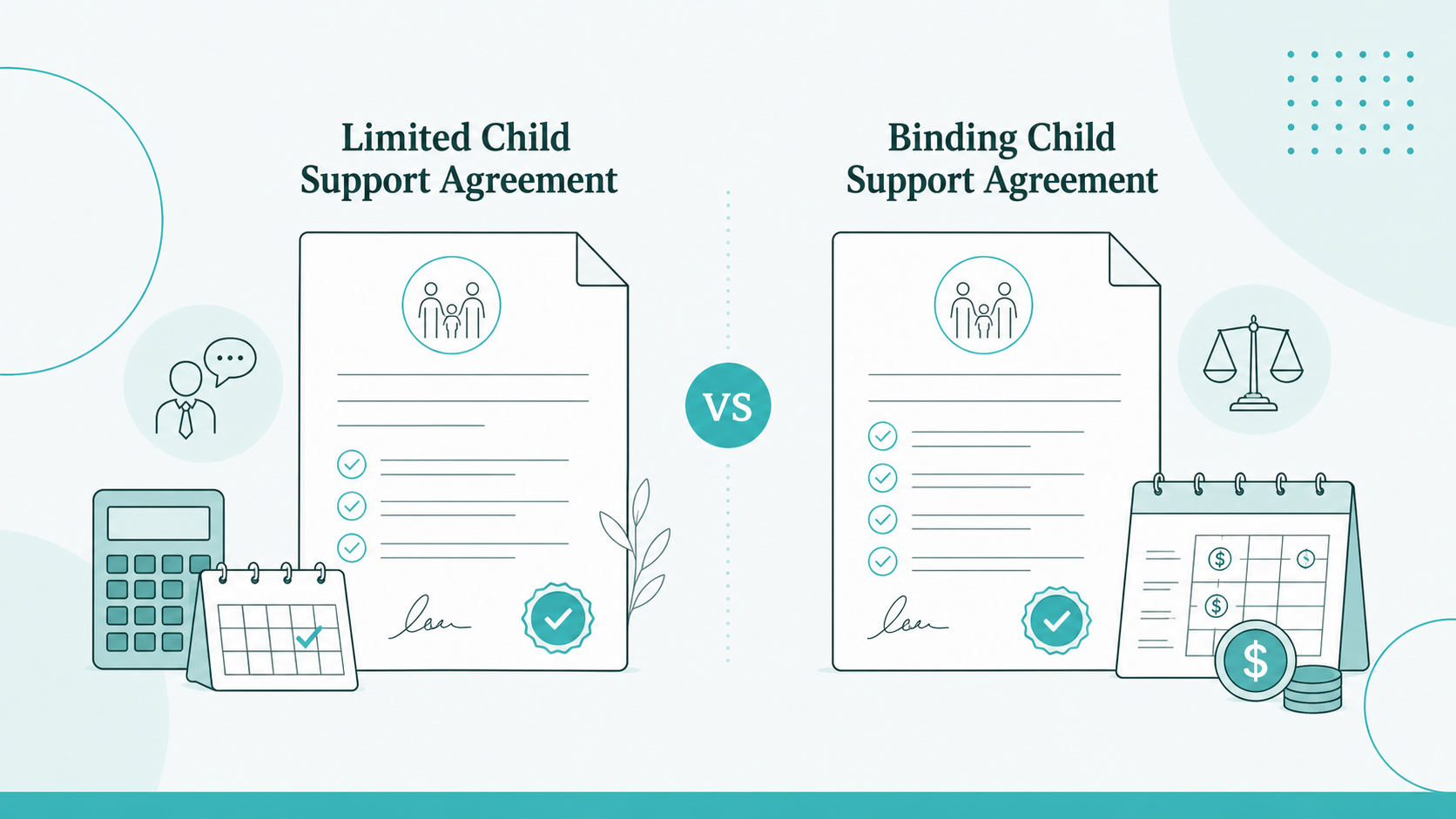
| Feature | Limited child support agreement | Binding child support agreement |
|---|---|---|
| Legal advice required? | Not mandatory, although advice can still be useful. | Mandatory independent legal advice for each party before signing. |
| Child support assessment required? | Usually yes. An administrative assessment must be in place before acceptance. | Not always, except for some types such as lump sum arrangements. |
| Payment amount | Generally must be at least the assessed annual rate payable by the same parent. | Can be more or less than the assessed amount, if properly agreed. |
| Flexibility to end | Usually easier to end, including after three years or in some assessment-change situations. | Harder to end. Usually requires a formal termination pathway, replacement agreement or court order. |
| Best suited to | Parents who want flexibility but still want the assessment as a baseline. | Parents who want long-term certainty and have had full legal advice about the risks. |
If you are still working out the ordinary formula amount, start with Awkar & Co’s guide to how child support is calculated in Australia. This article focuses on what happens when parents want to make their own formal arrangement.
Limited vs binding child support agreements: which one is better?
There is no universally better option. The better agreement is the one that suits the family’s circumstances, is properly documented, and does not create avoidable risk. A limited agreement may be better where the parents want flexibility and the assessed amount is an acceptable minimum. A binding agreement may be better where parents want greater certainty and understand the long-term consequences.
In practice, the choice often depends on these questions:
- Is there already a child support assessment?
- Is the agreed amount above, equal to, or below the assessment?
- Are the children’s care arrangements stable?
- Are school fees, health costs or special expenses predictable?
- Are both parents’ incomes stable?
- Does either parent receive Family Tax Benefit Part A?
- Is the agreement connected to property settlement, spousal maintenance or consent orders?
- What happens if one parent loses income, moves, remarries, has another child or changes care?
If those questions have not been answered, the agreement may not be ready to sign. Awkar & Co can help parents review the proposed terms and understand whether a child support agreement is the right pathway.
Child support agreements and care arrangements
Care arrangements matter because child support is linked to who cares for the child and for how much time. In general, a person must have at least 35% care to be treated as an eligible carer for child support purposes. If care changes, the financial effect of an agreement can become very different from what either parent expected.
The agreement should explain what happens if a child spends more time with one parent, moves primarily to the other parent, starts boarding school, turns 18, finishes secondary school, or stops living with the person who is receiving support. A vague agreement may produce conflict at exactly the moment the family needs clarity.
If parenting arrangements are still uncertain, it may help to first read Awkar & Co’s guides to how parenting arrangements are decided and parenting plans vs parenting orders.
Child support agreements and Family Tax Benefit
Child support agreements can affect Family Tax Benefit Part A. Services Australia may take into account child support a parent receives, or is entitled to receive, when calculating FTB Part A. This can be especially important where parents agree to private collection, non-cash payments, direct payment of school fees, lump sums or an amount that differs from the ordinary formula assessment.
Before signing, parents should check how the proposed agreement will be treated for family assistance purposes. A parent may be focused on the weekly payment amount but overlook the effect on Centrelink entitlements. Legal advice, financial advice and Services Australia guidance may all be relevant, depending on the family’s circumstances.
Child support agreements and property settlement
Child support agreements are sometimes negotiated at the same time as property settlement. For example, one parent may agree to pay school fees as part of a broader settlement, or the parties may discuss child support while finalising consent orders for property. This can be practical, but the documents need to be drafted carefully because property settlement and child support are different legal issues.
The DSS Child Support Guide notes that a document forming a property division order, parenting plan, maintenance agreement or financial agreement may also operate as a child support agreement if it complies with the necessary child support requirements. That is useful, but it is not something to assume. If a document is meant to operate as a binding child support agreement, it must satisfy the binding agreement rules.
If you are negotiating property at the same time, review Awkar & Co’s guide to property settlement after separation in South Australia.
Common risks in private child support agreements
The main risk is not that parents make an agreement. The main risk is that they make an agreement that does not match their future reality. Common issues include:
Mixing child support with parenting control
Child support agreements should not be used to control parenting decisions such as schooling choice, health care, extracurricular activities or changeover arrangements unless the broader parenting arrangement is properly addressed. A child support agreement can deal with payment obligations, but parenting decisions are a separate issue.
For example, an agreement that one parent will pay private school fees may work well if both parents genuinely agree that the child will remain at that school. It can become difficult if one parent later wants to change schools, the child’s needs change, or the cost becomes unaffordable. If schooling, travel, medical treatment or extracurricular expenses are important, the wording should be precise.
Agreeing to expenses without clear limits
Parents sometimes agree to pay “school expenses”, “medical costs” or “extracurricular activities” without defining what those terms mean. That can create disagreement later.
A better agreement usually explains:
- which expenses are covered;
- whether both parents must agree before the expense is incurred;
- whether the obligation covers public school, private school, uniforms, devices, tutoring, camps or excursions;
- whether medical expenses include private health insurance, gap payments, therapy, dental treatment or allied health costs;
- when invoices must be provided;
- when reimbursement must occur;
- whether there is an annual cap.
Without this detail, one parent may believe the agreement covers ordinary predictable costs, while the other may expect it to cover larger or discretionary expenses.
Failing to plan for changed income
A private arrangement may seem fair when both parents have stable income. It may not remain fair if one parent loses employment, becomes ill, starts a new business, has another child, moves interstate or takes on a greater share of care.
This is especially important with binding child support agreements because they are designed to be more formal and harder to change. A parent should not assume that a difficult financial situation will automatically release them from the agreement.
Using child support as part of a property settlement without clear drafting
Child support and property settlement can be negotiated at the same time, but they should not be treated as the same thing. Property settlement is about dividing the parties’ financial interests after separation. Child support is about the ongoing financial support of the child.
Problems can arise where one parent agrees to take less property, transfer an asset, pay a debt, or accept a smaller settlement on the understanding that child support will be reduced or handled separately. If the documents do not clearly record the legal effect of that arrangement, it may not achieve what either parent intended.
Where child support is being dealt with through lump sum payments, direct payment of expenses, property transfers or other non-periodic payments, the agreement needs careful legal review before it is signed.
Assuming an informal agreement is enough
Some parents reach an informal agreement by text message, email or verbal discussion. That may work while both parents cooperate, but it can become unreliable if communication breaks down.
An informal agreement may not be accepted or enforced in the way a parent expects. It may also create confusion if one parent later applies for an administrative assessment through Services Australia.
If the intention is to create a formal child support agreement, the document should be prepared properly and checked against the legal requirements for the type of agreement being used.
Not understanding the difference between limited and binding agreements
A limited child support agreement and a binding child support agreement are not the same.
A limited child support agreement is generally more flexible, but it still needs to meet formal requirements. A binding child support agreement is more serious. It can provide for child support above, below or different from the assessed amount, but both parties must receive independent legal advice before signing.
Parents should be careful not to sign a document described as “binding” unless they understand the consequences. Once signed, it may be difficult to change unless both parties agree or a legal basis exists to bring it to an end.
Not checking the impact on Centrelink or family tax benefit
Child support arrangements may affect family assistance, including Family Tax Benefit. This is often overlooked during private negotiations.
A parent may agree to receive a lower amount of child support, or to receive non-cash payments instead of periodic payments, without understanding how that may affect their overall financial position. Before signing, it is sensible to check the possible impact with Services Australia or obtain financial advice where needed.
Poor record keeping
Even where parents trust each other, records matter. If one parent is paying school fees, medical expenses, insurance, rent, mortgage payments or other agreed costs, both parties should keep clear records.
This may include:
- receipts;
- invoices;
- bank transfer records;
- screenshots of payments;
- emails confirming agreed expenses;
- records of reimbursement requests;
- proof of direct payments to schools, insurers or health providers.
Good records reduce disputes and make it easier to confirm whether the agreement has been followed.
What to check before signing a child support agreement
Before signing, consider whether the agreement clearly answers these questions:
- Who is paying and who is receiving child support?
- Which children are covered?
- What amount is paid, and how often?
- Does the agreement include direct payments to schools, insurers, doctors or providers?
- Are non-cash payments credited against periodic child support or paid in addition?
- Is there a child support assessment, and how does the agreement compare to it?
- How will private collect or Child Support Collect work?
- What happens if care arrangements change?
- What happens if income changes substantially?
- What happens when a child turns 18, finishes secondary school or changes school?
- How can the agreement be ended or replaced?
- Has each party obtained the legal advice required for a binding agreement?
If the agreement does not answer those questions, it may still need work. Careful drafting at the start can reduce disputes later.
When legal advice is especially important
Legal advice is required for a binding child support agreement. It is also sensible for many limited agreements, especially where the payments are significant or the children’s expenses are complex.
You should strongly consider advice if:
- one parent is paying private school fees, health insurance or major medical costs;
- the agreement is connected to a property settlement or financial agreement;
- the agreement is below the assessed child support amount;
- care arrangements are uncertain or disputed;
- one parent has irregular income, business income or trust/company interests;
- there are concerns about pressure, family violence, financial abuse or unequal bargaining power;
- one parent receives family assistance payments;
- you do not understand how the agreement can be ended.
Awkar & Co provides family law advice in South Australia and can help you understand the effect of a proposed agreement before you sign.
How Awkar & Co can help
If you are searching for a child support agreement lawyer or need child support legal advice before signing, the key question is not just whether the agreement can be accepted by Services Australia. It is whether the agreement is workable, clear, fair in context, and flexible enough for the children’s needs and the parents’ likely future circumstances.
A child support agreement can provide certainty, but only if it is the right type of agreement and the terms are clear. Awkar & Co can help parents in Adelaide, Norwood and across South Australia understand child support options, review proposed terms, explain the difference between limited and binding agreements, and advise on risks before an agreement is signed.
If you are considering a limited or binding child support agreement, get advice before signing. Awkar & Co can help you decide whether a private agreement, Services Australia assessment, negotiation, mediation or another pathway is appropriate for your circumstances. You can contact us through our contact page or learn more about our child support services.
Frequently asked questions about child support agreements in Australia
For parents in various areas of South Australia like Norwood, Kent Town, Stepney, Maylands, St Peters and College Park, Awkar & Co can provide local guidance on child support agreements before payments or private expenses are documented.
A child support agreement is a written agreement between parents, or between parents and an eligible non-parent carer, about child support payments. It can deal with periodic payments and, in some cases, non-cash or third-party expenses such as school fees, health insurance or medical costs. The two main formal types are limited child support agreements and binding child support agreements.
A limited agreement usually requires an existing Services Australia assessment and must generally provide at least the assessed annual rate. Independent legal advice is not mandatory. A binding agreement can be more flexible, including payments above or below the assessed rate, but each party must receive independent legal advice and the agreement must include the required certificates.
Yes. For a binding child support agreement, each party must receive independent legal advice before signing. The agreement must include statements and certificates confirming that advice. Without the required legal advice and documents, the agreement may not be accepted as a binding agreement and may not give either parent the certainty they expected.
Yes, a child support agreement may include cash payments and certain non-cash or third-party expenses, such as school fees, uniforms, private health insurance or medical costs. The wording needs to be clear about what is covered, when payments are due, how receipts are handled, and whether those payments are credited against ordinary child support.
A limited child support agreement can often be ended more easily than a binding agreement. It may be replaced by a new agreement, ended by written agreement, ended after it has been in place for more than three years, or ended in some cases where a notional assessment changes by more than 15% because of circumstances not contemplated by the agreement.
A binding child support agreement generally cannot simply be varied. If parents want different terms, they usually need to terminate the existing agreement properly and enter into a new binding agreement with fresh independent legal advice. In limited circumstances, a court may set aside an agreement, but this should not be assumed.
They can. Child support received, or taken to be received, may affect Family Tax Benefit Part A. Parents should check the Services Australia position before signing, especially if the agreement includes private collection, non-cash payments, school fees, lump sums or payments below the assessed child support rate.
You should be careful. Even where legal advice is not mandatory, a private child support agreement can affect cash flow, school fees, health costs, Family Tax Benefit, enforcement and future flexibility. Before signing, it is sensible to understand whether a limited agreement, binding agreement or Services Australia assessment better suits your circumstances.
Official resources
For general public information, you may also find these resources helpful: Services Australia on limited child support agreements and binding child support agreements, the Department of Social Services Child Support Guide on limited agreements, binding agreements and terminating child support agreements, and the South Australian Law Handbook on limited child support agreements.