
Child support in Australia exists to ensure children continue receiving financial support from both parents after separation. The system is administered nationally through Services Australia and applies a structured formula to determine how much each parent contributes toward the costs of raising their children.
For many parents navigating separation, understanding how child support works can feel confusing. Questions often arise about how payments are calculated, whether equal parenting arrangements affect payments, and what happens if a parent refuses to contribute financially.
At Awkar & Co, these questions frequently arise alongside parenting and property matters. With more than two decades practising family law, Linda Awkar has worked extensively in parenting disputes and matters involving children’s welfare, including cases where the Court appoints an Independent Children’s Lawyer to assist in determining what arrangements best promote a child’s interests.
This guide explains how child support works in Australia, how payments are calculated, what agreements parents can make, and the common misunderstandings that lead to disputes.
Quick Answer: How Child Support Works in Australia
Child support in Australia is calculated using a national formula that considers each parent’s income, the number of children, and how much time the children spend with each parent.
The calculation generally considers:
- Each parent’s income
- The percentage of care provided by each parent
- The number and ages of the children
- The estimated cost of raising children in Australia
The formula then determines whether one parent must make financial contributions to support the children’s living costs.
Assessments are typically managed by Services Australia, which administers the national child support scheme.
Why Child Support Exists
Australian law recognises that children should continue to be financially supported by both parents following separation. Child support exists to ensure children can maintain stability in areas such as housing, food, education and healthcare.
Child support obligations apply regardless of parenting arrangements. Even if a parent spends limited time with their child, they may still be required to contribute financially.
At the same time, the system recognises that parents who provide more day-to-day care also contribute financially through everyday expenses. This is why parenting arrangements influence child support calculations.
How Child Support Is Calculated In Australia
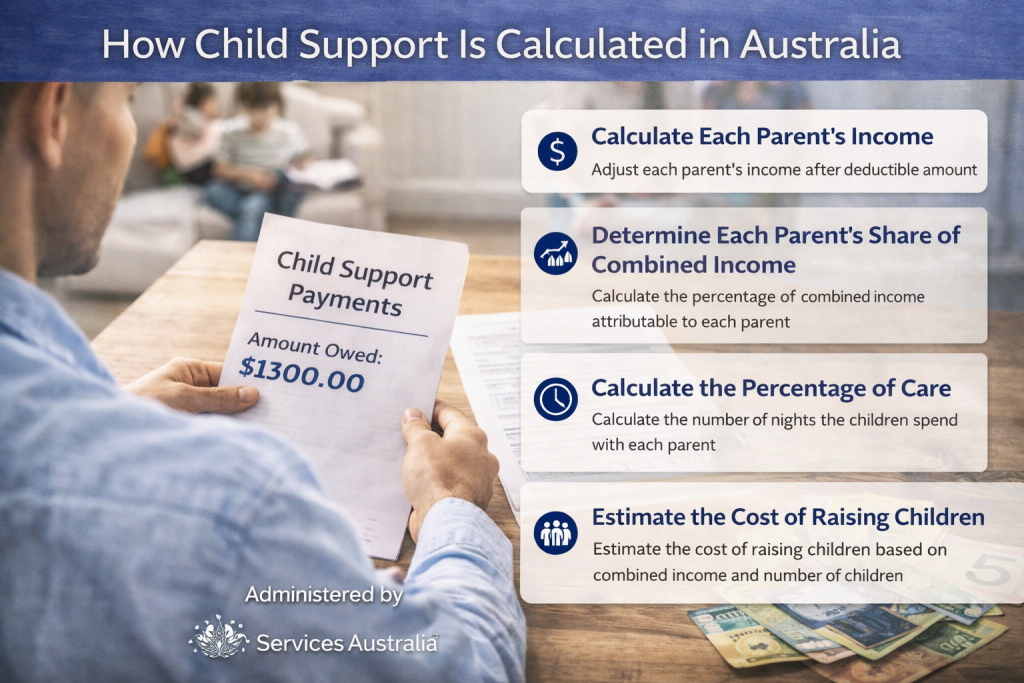
The child support formula is designed to estimate how much each parent should contribute toward the financial costs of raising their children.
While the formula itself is complex, it generally follows several steps.
Step 1: Calculate Each Parent’s Income
The first step involves determining each parent’s adjusted taxable income. This may include wages, salary, business income and certain benefits.
A self-support amount is deducted from each parent’s income to ensure that parents retain enough money for their own living expenses.
Step 2: Determine Each Parent’s Share of Combined Income
Once each parent’s income is calculated, the system determines what percentage of the combined parental income each parent contributes.
This percentage reflects how much financial responsibility each parent carries toward the children.
Step 3: Determine the Percentage of Care
The number of nights children spend with each parent is used to calculate the percentage of care provided.
Generally speaking, parents who provide more care contribute financially through day-to-day expenses such as housing, food and clothing. This may reduce the amount of child support payable.
Step 4: Estimate the Cost of Raising Children
The system uses national economic data to estimate the cost of raising children based on:
- Combined parental income
- Number of children
- Ages of the children
These estimated costs form the basis of the final child support calculation.
Child Support Calculator Australia
Services Australia provides an online child support estimator that allows parents to calculate a rough estimate of child support payments.
The calculator uses the same general formula as the formal assessment and can give parents an idea of what payments may look like.
However, the actual assessment may differ depending on individual circumstances, including additional children, income changes, or special circumstances.
What does child support cover in australia
In short: Australia, child support is designed to cover the day to day costs of raising a child
This is What You Need to Know
In Australia, child support is designed to cover the day to day costs of raising a child Services Australia uses a standard formula to calculate child support payments based on each parents income and care arrangements, the recipient parent has discretion to use funds for the child’s overall wellbeing.
Standard assessments are intended to contribute to the following:
- Housing & Utilities: This includes a contribution toward rent or mortgage payments, as well as essential services like electricity, water, and gas.
- Food & Essentials: Everyday groceries, nutritious meals, clothing, footwear, and personal toiletries.
- Education: Covers public school fees, mandatory uniforms, textbooks, stationery, and required excursions.
- Healthcare: Standard GP visits, vaccinations, prescription medications, and basic dental check-ups.
- Transportation: Costs for commuting to school, sports practice, or visiting friends, including petrol or public transport fares
| Expense Type | Estimated Cost | Inclusions |
|---|---|---|
| Housing & Utilities | $5,000 | Rent/mortgage, electricity, gas |
| Everyday Essentials | $4,000 | Food, clothes, transport |
| Education (Public) | $3,000 | Fees, uniforms, books |
| Healthcare | $1,000 | GP visits, medications |
“The above table is per annum based on averages from 2026.”
Does 50/50 Parenting Mean No Child Support?
No. Equal parenting time does not automatically eliminate child support obligations.
If one parent earns significantly more income than the other, child support may still be payable even when care is shared equally.
This often surprises parents who assume that equal parenting arrangements automatically cancel financial obligations.
In reality, the system aims to ensure that children receive financial support from both parents based on their financial capacity.
Private Child Support Agreements
Parents are not limited to the standard child support formula. In some situations, parents may enter private agreements that better reflect their financial arrangements.
Private agreements can offer flexibility that the standard formula does not always provide.
Limited Child Support Agreements
Limited agreements allow parents to agree on child support payments that may differ from the formula assessment.
These agreements require an existing child support assessment and can be updated more easily than binding agreements.
Binding Child Support Agreements
Binding child support agreements are more formal and require both parents to obtain independent legal advice before signing.
These agreements can include arrangements such as:
- Regular payments
- Lump sum contributions
- Payment of school fees
- Medical or healthcare expenses
- Extracurricular activities
Binding agreements can provide long-term certainty but should be carefully drafted to ensure they remain fair and enforceable.
When Child Support Starts and Stops
Child support usually begins once parents separate and an assessment is made through Services Australia.
In most cases, child support continues until a child turns 18.
However, there are circumstances where financial support may continue beyond age 18. For example, the Court may order adult child maintenance if a child remains financially dependent due to education or other circumstances.
Change of Assessment
The standard formula does not always reflect a family’s actual financial situation. In these cases, parents may apply for a change of assessment.
A reassessment may be considered where special circumstances exist, including:
- Private school fees
- Significant medical costs
- Special needs of the child
- A parent who is income poor but asset rich
- Unusual financial arrangements
Applications for a change of assessment require evidence and careful preparation.
Child Support for High Income Parents
In some situations, parents with very high incomes may find that the standard formula does not accurately reflect the lifestyle or financial circumstances of the family.
High-income cases may involve additional considerations such as private education, international schooling, or substantial extracurricular activities.
These matters often require careful legal advice to ensure that financial arrangements properly reflect the needs of the children.
What Happens If a Parent Hides Income?
One of the most common disputes in child support matters arises when one parent believes the other is not accurately reporting their income.
For example, disputes may arise where a parent:
- Operates a business and minimises taxable income
- Receives income through trusts or companies
- Has substantial assets but low reported income
In these situations, the child support system may allow reassessment based on the parent’s real financial capacity.
These cases can become complex and often require careful investigation.
What Happens If Child Support Is Not Paid?
Services Australia has enforcement powers to recover unpaid child support.
These powers may include:
- Garnishing wages directly from an employer
- Intercepting tax refunds
- Preventing overseas travel
- Taking legal enforcement action
Unpaid child support can accumulate quickly, which is why early intervention and clear advice are often important.
Child Support and Parenting Orders
Child support and parenting arrangements operate as separate legal frameworks.
Parenting orders determine where children live and how much time they spend with each parent. Child support focuses solely on financial contributions.
However, parenting arrangements can influence child support because the percentage of care affects the final calculation.
For example, if a parent begins spending significantly more time with their children, the child support assessment may change.
Child Support and Remarriage
Child support obligations are based on parental responsibility, not marital status.
If a parent remarries or begins a new relationship, this does not automatically end or reduce their child support obligations.
However, financial circumstances may still be reviewed if income or care arrangements change.
Common Child Support Mistakes Parents Make
Many disputes arise from misunderstandings about how the child support system works.
Some of the most common mistakes include:
- Assuming equal care means no payments
- Failing to formalise child support agreements
- Ignoring changes in income or employment
- Not updating parenting arrangements
- Relying on informal financial arrangements
Clear advice early in the separation process can prevent disputes that later become financially and emotionally costly.
Frequently Asked Questions About Child Support
How much child support do I have to pay?
The amount depends on both parents’ income, the number of children, and how much time the children spend with each parent.
Does child support change if my income changes?
Yes. Child support assessments may be updated if income levels change or if parenting arrangements change.
Can parents make their own child support agreement?
Yes. Parents may enter limited or binding child support agreements that provide flexibility beyond the standard formula.
Do I still pay child support if my ex remarries?
Yes. Child support obligations are based on parental responsibility and continue regardless of remarriage.
Can child support be changed?
Yes. Parents may apply for reassessment if circumstances change significantly.
Getting Advice About Child Support
Child support arrangements can significantly affect long-term financial stability for families after separation.
Understanding how the system works — and when private agreements may be appropriate — can reduce conflict and provide clarity for parents.
With more than 20 years practising family law and extensive experience in parenting matters involving children’s welfare, Awkar & Co assists parents in understanding child support obligations alongside parenting and financial arrangements.
Early advice can help parents understand their obligations, explore agreement options, and avoid disputes that may otherwise become complex or costly. Contact Linda Awkar now.