
“Child custody” is the term most people use when asking who children will live with after separation. In Australian family law child custody , the correct legal terminology is parenting arrangements and parenting orders.
Australian law does not focus on parental rights. It focuses on the best interests of the child. Every parenting decision — whether agreed privately or determined by the Court — is measured against that principle.
At Awkar & Co, parenting matters are approached with careful attention to evidence, safety, and long-term stability. Linda Awkar has more than 20 years’ experience in family law child custody and has acted in complex parenting disputes, including matters where the Court appoints an Independent Children’s Lawyer (ICL) to represent a child’s best interests.
Quick Answer: How is child custody decided in Australia?
Answer: Parenting arrangements are decided based on the child’s best interests, with the Court considering safety, meaningful relationships, and practical realities.
The governing framework is set out in the Family Law Act. Official Court guidance is available here:
Parenting & Children – Federal Circuit and Family Court of Australia
Is 50/50 custody automatic in Australia?
Answer: No. Equal time is not automatic. It is only considered if it is in the child’s best interests and reasonably practicable.
In practice, equal time arrangements work best where:
- There are no safety concerns
- Parents can communicate effectively
- Geography supports the arrangement
- The child’s schooling and routine remain stable
In contested parenting proceedings, equal time is often discussed, but the Court carefully examines practicality and impact before making such an order.
What does an Independent Children’s Lawyer (ICL) do?
Answer (snippet-ready): An Independent Children’s Lawyer is appointed by the Court in complex parenting disputes to independently represent the child’s best interests.
An ICL does not act for either parent. Instead, they:
- Review evidence and family reports
- Cross-examine witnesses where necessary
- Test each parent’s proposals
- Advocate for outcomes that promote the child’s welfare
Linda Awkar has acted in matters involving ICL appointments, which provides direct insight into how Courts assess risk, parental capacity, and long-term stability.
This perspective matters. It means parenting advice is informed not only by client advocacy, but by understanding how children’s interests are evaluated from the Court’s vantage point.
What does “equal shared parental responsibility” mean?
Answer: Equal shared parental responsibility refers to joint decision-making about major long-term issues — not equal time.
It relates to decisions about:
- Education
- Major medical treatment
- Religious upbringing
- Significant long-term welfare decisions
It does not automatically result in 50/50 living arrangements.
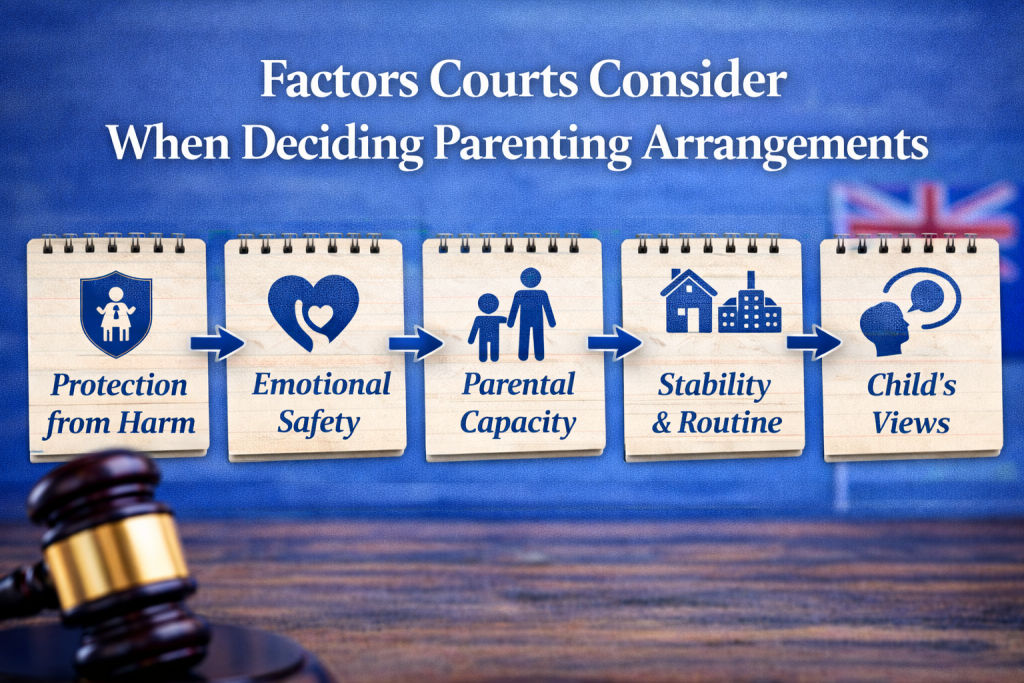
What factors does the Court consider in custody disputes?
Answer: The Court considers safety, meaningful relationships, stability, parental capacity, and the child’s views (depending on age and maturity).
Key considerations include:
- Protection from harm
- Emotional and psychological safety
- Each parent’s ability to meet the child’s needs
- Practical arrangements (schooling, distance, schedules)
- The benefit of ongoing meaningful relationships
In matters involving allegations of family violence or risk, safety considerations can outweigh equal time proposals.
Experience in complex parenting disputes shows that Courts assess credibility closely. Consistency in communication and evidence often becomes decisive.
Do mothers automatically get custody in Australia?
Answer: No. Australian law does not favour mothers or fathers. Decisions are gender-neutral and based on best interests.
Parenting outcomes depend on evidence, caregiving history, and practical capacity — not gender.
Can fathers get equal custody?
Answer: Yes. Fathers can obtain equal time where it is in the child’s best interests and practicable.
Modern parenting decisions focus on each parent’s capacity to provide stability, not traditional assumptions.
What if we agree on parenting arrangements?
If agreement is reached, arrangements can be documented through:
- Parenting plans (informal, not legally enforceable)
- Consent orders (legally binding Court orders)
Consent orders provide enforceability and reduce the risk of later disputes.
What happens if we cannot agree?
Parents are generally required to attempt family dispute resolution before filing Court proceedings, unless exceptions apply.
If Court proceedings commence, the matter may involve:
- Interim hearings
- Family reports
- Independent Children’s Lawyer appointment (in complex cases)
- Final hearing
In high-conflict matters, strategic preparation and evidence discipline significantly influence outcomes.
What age can a child decide where they live?
Answer: There is no fixed age. A child’s views may be considered depending on maturity and understanding.
The Court weighs a child’s wishes alongside other factors. It is not a simple election between parents.
Common mistakes in custody disputes
- Sending hostile messages that later become evidence
- Withholding children without lawful justification
- Failing to comply with interim arrangements
- Overlooking documentation of incidents
- Focusing on parental grievances rather than child outcomes
Courts respond to structured, child-focused proposals. Emotional escalation usually weakens a party’s position.
Child Custody in South Australia
Parenting matters in South Australia are heard in the Federal Circuit and Family Court of Australia.
Local practice and case management influence timelines, but the governing principles remain federal.
Where complex issues arise — including risk allegations, relocation disputes, or entrenched conflict — experience in Court-appointed child-focused roles provides valuable insight into how parenting evidence is evaluated.
FAQs
How is child custody decided in Australia?
Answer: Parenting arrangements are determined based on the child’s best interests, prioritising safety, stability, and meaningful relationships.
Is 50/50 custody automatic?
Answer: No. Equal time is only ordered if it is in the child’s best interests and reasonably practicable.
Can a father get equal custody?
Answer: Yes. Parenting decisions are gender-neutral and based on best interests.
What does an Independent Children’s Lawyer do?
Answer: An ICL is appointed by the Court in complex cases to independently represent the child’s best interests.
Do I have to go to Court for family law child custody?
Answer: No. Many parenting matters resolve through agreement or mediation and are formalised through consent orders.
Next Step: Protect Your Relationship With Your Child
Parenting disputes are rarely about “winning.” They are about protecting children from conflict and ensuring stability moving forward.
With more than 20 years practising family law, including involvement in matters where children’s interests are independently represented, Awkar & Co approaches parenting disputes with measured strategy and child-focused clarity.
Related Information
Book a confidential consultation | Learn more about Parenting Arrangements